
Beta
Introducing Synthetic Audiences
Synthetic testing gives you a fast prediction of what real people would choose, built from years of actual PickFu respondents' survey answers. Screen your ideas in under a minute, then confirm with real consumers. Free for a limited time.
- 300+
- synthetic audiences across 25 product categories
- ~200
- profile traits behind every synthetic respondent
- 100s
- of past PickFu surveys behind each result
- < 1 min
- from question to results
How it works
Where synthetic fits in your workflow
Synthetic decides what to test. Real people decide what to do.
- 1
Start with an early idea or several options
Share a rough concept, or generate several names, taglines, images, or other options.
- 2
Screen with a synthetic audience
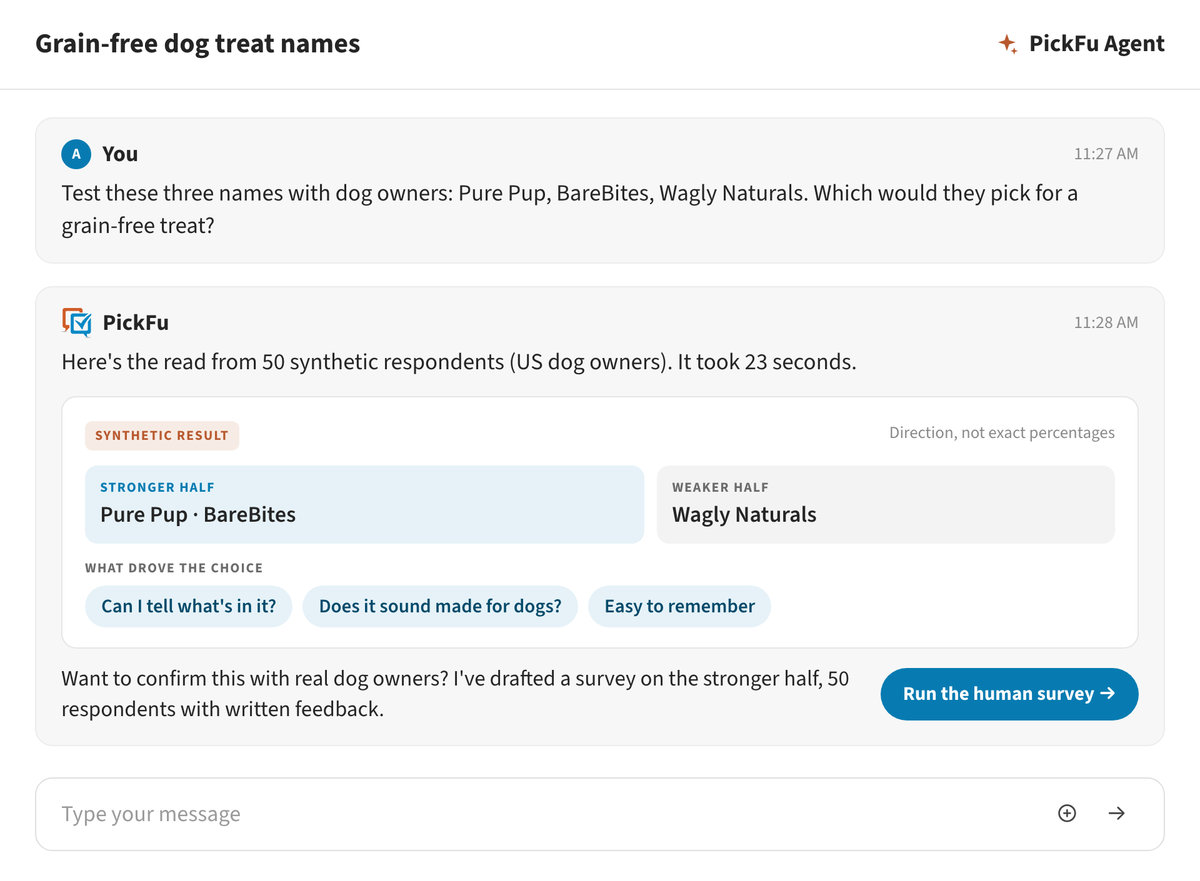
Results in under a minute. Cut eight names down to the two worth testing with real people.
- 3
Improve the survivors
Use the themes behind the split to refine, then retest. Run as many rounds as you want.
- 4
Confirm with real people
The PickFu Agent offers a ready-to-launch human survey on your strongest option, with written feedback from every respondent.
Why it's not just asking ChatGPT
Ask a general AI to act like a dog owner and it invents one. Ours starts with real dog owners on our panel.
Starts with real people
Around 200 traits, plus real choices from past PickFu surveys, from panelists like the people you want to reach.
Becomes a synthetic respondent
It predicts what that type of person would choose. It has no opinions of its own.
Dozens of them vote
A result is dozens of separate predictions counted into a vote, not one AI's summary of what it thinks people want.
Checked against real people on hundreds of past PickFu surveys
Two ways to run it
Both run through the PickFu Agent in the web app or Slack, or through PickFu's MCP in tools like Claude. Generate, test, refine and retest without leaving the tools you already use.
Comparison
A question and 2–10 options, text or images. You get the stronger and weaker half, the themes behind the split, and a one-line reason from each synthetic respondent.
Single concept
One idea and one open question. You get a summary, the themes, where segments disagreed, and the follow-up questions worth asking.
In two days, I ran over a hundred synthetic tests for two non-fiction books. I rebuilt a back cover on the first round’s findings and tested it again the same afternoon, so research became part of drafting rather than a verdict at the end. The value is in the reasons more than the rankings. And it gave me a short, specific list of what to put to PickFu’s human panel before my proposal went out.
Where synthetic is strongest
Synthetic is genuinely good at some jobs and not others. Here's the honest split.
Start with Synthetic Audiences
- Narrowing a long list to the few worth testing with real people
- Text comparisons: names, titles, taglines, claims, pricing
- Early ideas, plus content, feature, clarity and trust questions
- Image comparisons where the options are clearly different
Go to real people
- Aesthetic calls and anything genuinely new
- Emotionally loaded questions: money, health, identity
- Expensive or hard-to-reverse decisions, like final packaging
- When you need the actual margin, individual responses, or evidence for a buyer or investor
Why you can trust the results
We built our synthetic respondents from real consumer data, and we're just as open about where they fall short.
Benchmarked against real people
We replay past surveys where we already know what real people picked and score the synthetic respondents against them. We can do that because we run a human panel.
Honest about limits
Synthetic is strong on text and weaker on images and emotion. Results show a stronger and weaker half, and we'll tell you to trust the direction more than the size of the gap.
Never mixed with human results
Synthetic only runs when you ask for it, and every result is labeled synthetic. We never combine synthetic and human surveys or results.
Frequently asked questions
Is this replacing PickFu's human panel?
No. Our human respondents aren't going anywhere, and our synthetic respondents are modeled on them. Synthetic helps you decide what to test. Real people help you decide what to do. Our confidence in synthetic comes from the human panel, because that's what we score it against.
How is this different from just asking ChatGPT?
Ask ChatGPT to be a dog owner and it imagines one. A PickFu synthetic respondent is built from real choices that dog owners made on real surveys, including what they turned down. Every result is dozens of separate predictions counted together, not one model's summary of what it thinks people think. And because we run a human panel, we can measure how close it gets instead of asserting it.
How accurate is it?
We benchmark it against hundreds of past PickFu surveys where we already know what real people chose. It picks the same side as real people most of the time on text comparisons, and less often on images. It's in beta, and we keep testing and adjusting the models.
Two things matter when you read a result. Margins run wider than human ones, so if you ask for the exact split, trust the direction more than the size of the gap. And accuracy for any single audience isn't validated yet, so we won't quote a number for one.
When should I use synthetic respondents instead of real people?
Use synthetic to narrow, and real people to decide. Synthetic feedback is fast, and free for a limited time during the beta, which makes it ideal for screening a long list — eight names down to the two worth testing — or getting an early read on a rough concept.
When the decision is expensive or hard to reverse, purely aesthetic, emotionally loaded, or genuinely new territory, run it with real respondents. Same when you need the actual margin rather than just the direction.
What does it cost?
Nothing right now. Synthetic tests are free for a limited time while Synthetic Audiences is in beta. If you go on to run a human survey on the stronger option, that's priced like any other PickFu survey, and you'll see the price and confirm it before anything runs.
Which audiences are available?
Over 300 audiences across 25 product categories. Coverage is deepest in supplements, health and household, beauty, books, and grocery. Each category is sliced by trait and demographic — dog owners in pet food, people who read 4+ books a month, daily supplement takers — rather than a generic consumer.
A few limits. Audiences are US-only today, there are no geographic slices within the US, a test runs against one audience rather than a combination, and we can't yet build audiences from your own customers or on request. If the audience you need isn't there, tell us. That's how we're prioritizing what to add.
How many synthetic respondents should I use?
Thirty to 50 for most tests. The cap is 75. Past about 50, each extra respondent adds very little, because synthetic responses converge.
Each one stands for a type of real respondent rather than a single individual, so what you get back is themes and patterns rather than individual variance. That's why a bigger sample doesn't buy you much here.
Why did I get different numbers when I ran the same test twice?
Each run draws a fresh set of synthetic respondents at random, and the model behind them isn't deterministic. The grouping into stronger and weaker options should hold, along with the themes. The exact split will move. Treat the split as direction, not measurement.
How do I know the human responses are human, and the synthetic ones are kept separate?
They never mix. Synthetic only runs when you explicitly ask for it through the PickFu Agent or the synthetic tools in the MCP and API, and results come back labeled as synthetic. Synthetic responses can't end up in a human survey by mistake, and we never pool them with human results.
Every human response comes from PickFu's respondent panel, which goes through multiple layers of quality and identity checks, and you get written answers and demographics from each respondent.
Is my survey data used to build synthetic respondents?
Not in any identifiable form. Synthetic respondents are built from panelists' answer histories, and survey and respondent IDs are hashed before anything reaches the model, so nothing in the data behind a synthetic respondent can be traced back to your surveys. Your results are never shared with respondents or with other customers. PickFu may use survey data to improve our own product.
Can I use it now?
Yes. Synthetic Audiences is in beta and open to all PickFu users, free for a limited time. Sign up for a free account or log in, then run a synthetic test through the PickFu Agent or PickFu's MCP.
Start testing with synthetic respondents
Synthetic Audiences is in beta and open to all PickFu users, free for a limited time.
Sign up for free